The Great Marketing Shift Everyone Ignored
Remember when marketing was predictable? You had a defined playbook: create a message, choose a channel, measure the results. It wasn’t simple, but it was knowable.
You could control the narrative. You could reach your audience on your terms. A billboard didn’t talk back. A TV commercial didn’t argue with you. An email blast didn’t ask uncomfortable questions.
Marketing was a monologue, and you got to write the script.
Then something shifted. People got devices in their pockets that let them talk back. They started sharing opinions, asking questions, and calling out inauthenticity in real time. The old broadcast model—still effective at scale—suddenly felt tone-deaf and one-directional.
But here’s what we’re wondering: Has your organization actually adapted? Or are you still operating like it’s 2010?
You already know conversation design is the future. You’re just hoping you can keep broadcasting a little longer before you have to change.
Conversation Design: Marketing as Dialogue, Not Broadcast
The Old Question (Still Haunting Us)
For decades, marketers asked: How do we reach people? This was a logistics problem. How many eyeballs can we get in front of? What’s the cheapest CPM? Can we interrupt them at the right moment?
The metrics were straightforward: impressions, reach, frequency. Success meant your message was seen, whether people cared or not.
The New Question (That Keeps Us Up at Night)
Now the question is messier, more human, and infinitely more interesting: How do we talk with people?
But here’s what we’re genuinely curious about: Are you actually asking this question? Or does it still feel theoretical?
Because we talk to marketing teams all the time, and most of them are stuck somewhere in between. They want to have conversations. They just don’t know how to structure for it.
So let’s be honest about what this shift actually requires:
-
- From broadcast to dialogue – You’re not transmitting; you’re listening and responding
- From audience to community – People aren’t passive consumers; they’re participants
- From messages to conversations – Your brand doesn’t have a script; it has a personality and opinions
- From reach to relevance – One genuine conversation beats a thousand disinterested impressions
Think about the brands you actually like. Do you love them because of their billboard on the highway? Or because they’ve earned your trust through genuine, consistent interaction?
What’s your answer? And more importantly—are you the brand in that scenario, or are you hoping to be?
The Structural Changes That Actually Need to Happen
Here’s what we keep seeing: most organizations aren’t structured for conversation. And honestly? We get why.
Your organization probably looks something like this:
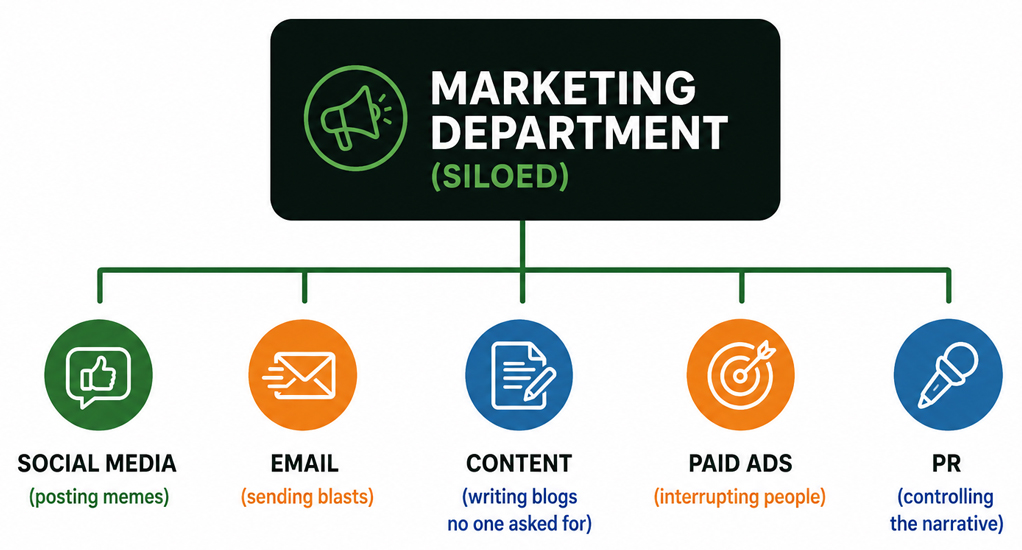
None of these people talk to each other. None of them have permission to actually respond to customers in real time.
But here’s the question we’d ask you: Does this describe your organization? And if it does, what would need to change?
Because we don’t have all the answers. Every organization is different. But we’ve noticed some patterns in the ones that are actually making this work:
1. Break Down the Silos (If You Can)
Marketing, customer service, product, and sales need visibility into each other’s work. When someone asks a question on social media, the response can’t take 48 hours while it bounces between departments.
But we know this is hard. You probably have budget structures that don’t allow it. You probably have people who’ve been in their roles for years. What’s the actual barrier in your organization? What would make this possible?
2. Give People Permission to Be Human
Your social media manager can’t respond to every comment with corporate-speak written by committee. They need guidelines, not scripts. They need autonomy to be real.
This terrifies most organizations. We get it. But the teams that are doing this well? They’re not running wild. They have principles, not policies.
What would it look like if your team had permission to be themselves? What would you be afraid of?
3. Listen More Than You Broadcast
This one’s simple in theory: spend 80% of your energy listening and understanding what people actually want to talk about. The other 20% is participating in those conversations naturally.
But in practice? Most organizations have it backwards. They spend 80% broadcasting and 20% listening (if that).
If you flipped that ratio tomorrow, what would you discover? What conversations are you missing right now?
4. Build Feedback Loops Into Everything
You need systems where customer feedback directly influences product, messaging, and strategy. Not quarterly reviews—real-time adaptation.
This is where things get uncomfortable. Because it means you’re not in control. The conversation shapes your decisions.
Are you ready for that? What would your organization look like if customers actually influenced your strategy?
5. Invest in Relationships, Not Transactions
Stop optimizing for clicks and conversions in the next 30 seconds. Build systems that nurture relationships over months and years.
This requires patience. It requires faith. It requires metrics that your CFO might not understand.
What would happen if you measured success by relationship depth instead of conversion rate? Would your board support that?
Why Most Brands Still Can’t Do This
We’ve been thinking about this a lot, and we don’t think brands are bad or stupid for not doing conversation design. We think there are real, legitimate reasons why this is hard.
Reason #1: Fear of Losing Control
Conversation is messy. People might say things you didn’t anticipate. They might disagree with you. They might ask questions you can’t answer.
So instead of embracing the chaos, brands create 47-step approval processes for a single social media post. By the time it’s approved, the conversation has moved on.
We’re curious: What are you actually afraid of? What’s the worst-case scenario in your head?
Reason #2: Legacy Systems Built for Broadcast
Your email platform was designed to send to millions. Your ad platform was designed for targeting. Your CRM was designed to track transactions. None of these tools are built for conversation.
Ripping out infrastructure is expensive. It’s risky. We understand.
But what’s the cost of not changing? How many conversations are you missing because your tools don’t support them?
Reason #3: You Can’t Measure Conversation Like You Measure Broadcast
With traditional marketing, success is simple: Did the ad run? Did people click? Did they buy?
With conversation, it’s harder. How do you measure trust? How do you quantify the value of a genuine relationship? The CFO wants a number. You’re offering a feeling.
What if you tracked different metrics? What would you need to measure to prove that conversation design actually works?
Reason #4: It Requires Different Skills
Broadcast marketing is a craft. Conversation design is an art and a psychology experiment. You need empathy, authenticity, and the ability to read a room.
Most marketing teams were hired to be good at broadcast. That’s not their fault. That’s what the job was.
Do you have people on your team who are naturally good at conversation? And if you do, are you using them for that, or are they stuck writing email blasts?
Reason #5: It’s Slower
Broadcast is efficient. You send a message to a million people. Conversation is intimate. You engage with one person at a time.
In a world obsessed with growth hacking and viral moments, genuine conversation looks like it’s not working. Until it does.
Are you willing to go slower? Or is growth the non-negotiable metric?
What We’ve Noticed About Brands That Are Doing This
Wendy’s, Patagonia, Slack—they get a lot of attention. But honestly? We’re more interested in the smaller organizations that are quietly building real community.
The ones that:
-
- Show up in conversations they didn’t start
- Admit when they’re wrong
- Ask questions they don’t have answers to
- Build relationships with specific people, not just audiences
- Let the community shape their decisions
Do you know any brands like this? What are they doing differently?
So What Now?
Here’s what we’re not going to do: tell you that conversation design is easy or that you should do it tomorrow.
Here’s what we are going to do: ask you some questions.
Pick one:
-
- Listen to what people are actually saying about your brand (and your industry). Not what you think they’re saying. What are they actually talking about?
- Find one conversation you’re not part of but should be. Where are your people gathering? What are they discussing? How could you show up authentically?
- Ask your team: What would need to change for us to respond to customers in real time? What’s stopping us?
- Identify one person in your organization who’s naturally good at conversation. What are they doing right now? Could they be doing this instead?
- Define what “success” looks like if you shift toward conversation. Not reach. Not clicks. What would actually matter?
Pick the one that makes you most uncomfortable. Start there.
Because here’s the honest truth: conversation design isn’t the future of marketing. It’s the present. But it’s not a strategy you implement. It’s a fundamental shift in how you think about your relationship with the people you serve.
It’s slower. It’s messier. It requires you to give up some control.
But people don’t want to be broadcast to. They want to be talked with.
What would change if you actually did that?
We’d genuinely love to know. Drop a comment. Tell us what you’re struggling with. Tell us what’s working. Tell us what we’re missing.
Because that’s conversation design.